
Best Time to Visit Ethiopia
Best Time to Visit Ethiopia
Ethiopia experiences less rainfall between September and February, making this period a time to take advantage of the sights without the concern of heavy rains.
Climate and Weather of Ethiopia
Although latitude would have one think that Ethiopia would be a tropical country, its high elevation means that much of Ethiopia experiences a temperate climate. However, this classification can also be deceiving, as the climate varies greatly depending on the region. While average temperatures in the highlands hover around 17°C (62.6°F), the lowlands experience tropical temperatures of about 28°C (82.4°F).
Meanwhile, the far eastern portions of the Somali and Afar regions are characterized by desert or semi-desert conditions.
Rainy Seasons of Ethiopia
The two rainy seasons in Ethiopia occur from March to April and June to August, with the dry seasons being from September to February and also the month of May. It is generally coldest in December and January, and warmest during the period of March to May.
Still deciding where to go?
Knowing when to travel is half the decision; the other half is where. Our guide to African safari destinations puts every country we work in side by side — what each is best for, the best months to visit, how long to allow and what a trip starts at — so you can see how Ethiopia compares before you commit.
Best time to visit Ethiopia: common questions
When is the best time to visit Ethiopia?
October to March is the working window, and October to November is the best of it. The main rains — the kiremt — run June to September, and once they end the highlands are green, wildflowers are out, the air is clear and the Simien and Bale escarpments give their longest views of the year. Bega, the dry season proper, runs November to February and is the main travel season. The lighter belg rains fall March to May with afternoon showers around seven to ten days a month.
When are Timkat and Meskel?
Timkat, the Ethiopian Epiphany, falls on 19 January, or 20 January in a leap year, and is celebrated most spectacularly at Gondar’s Fasilides Bath, at Lalibela and in Addis. Meskel falls on 27 September, or 28 September in the Ethiopian leap year, with the Demera bonfire in Meskel Square the evening before. Unusually for Africa, these are hard dates rather than probabilities — which makes them genuinely bookable. What is not predictable is accommodation: Gondar at Timkat and Lalibela at Genna sell out a year ahead.
When can I see Ethiopian wolves and gelada?
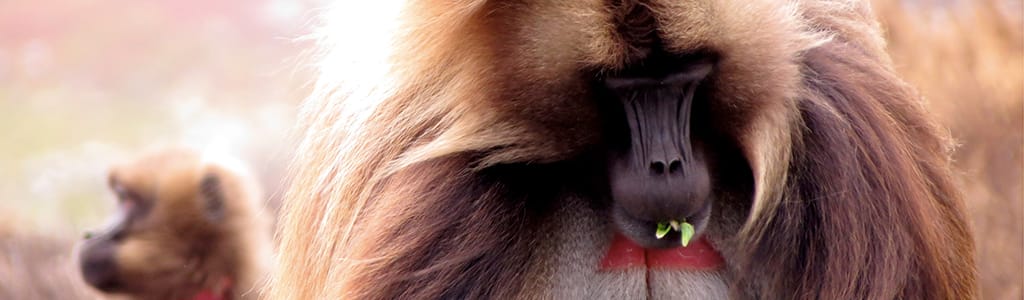
Ethiopian wolves — the world’s rarest canid, with around 500 animals left — are on the Bale Mountains’ Sanetti Plateau, best from November to March when the plateau is dry enough to drive and the wolves hunt giant molerats in daylight on open Afroalpine moorland. Bale is where you go for wolves; they are rarely seen in the Simiens. Gelada in the Simiens are resident and reliable year-round, so the constraint there is trail conditions and visibility rather than animal presence. Birding peaks November to February.
Is the end of the rains really worth considering?
It may be the most beautiful time in the Ethiopian highlands, and it is the season everyone tells you to avoid. From late September through October the plateau is emerald green, the adey abeba daisy blooms across the highlands in yellow drifts, waterfalls including the Blue Nile Falls run at full flow, and the air is scrubbed clear. Meskel falls on 27 September, at exactly that moment. It is also priced below the December and January peak.
Which months should I avoid in Ethiopia?
July and August, the height of the kiremt. Simien and Bale trekking is fogged out and muddy, Omo Valley roads are cut, northern-circuit transfers become slow and unreliable, and the Danakil is both unbearably hot and logistically fraught. June is the ramp-up. Two things worth adding: the Blue Nile Falls can be reduced to a fraction of their width outside the high-flow months because of hydroelectric abstraction upstream, and access to some regions has at times been constrained by security rather than weather — a live operational question we check separately for every trip.
How cold does it get?
Colder than guests expect, because they do not think of Ethiopia as a mountain destination. Ethiopia’s dry season and its cold season are the same thing at altitude: nights in the Simiens in December and January drop below freezing at camp, and the Sanetti Plateau at 4,000 metres is subject to hail, sleet and near-freezing nights in any month. Addis itself sits at around 2,355 metres, so guests arrive at altitude straight off a long flight.